
How to Take Card Payments as a Tradesperson (UK Guide)
Cash and bank transfer are costing you more than card fees do. The real options, what the fees actually buy, and the questions that sort the market.
Last edited: 03 Oct 2026
Everything described here runs on the same diary you can open in the live demo.
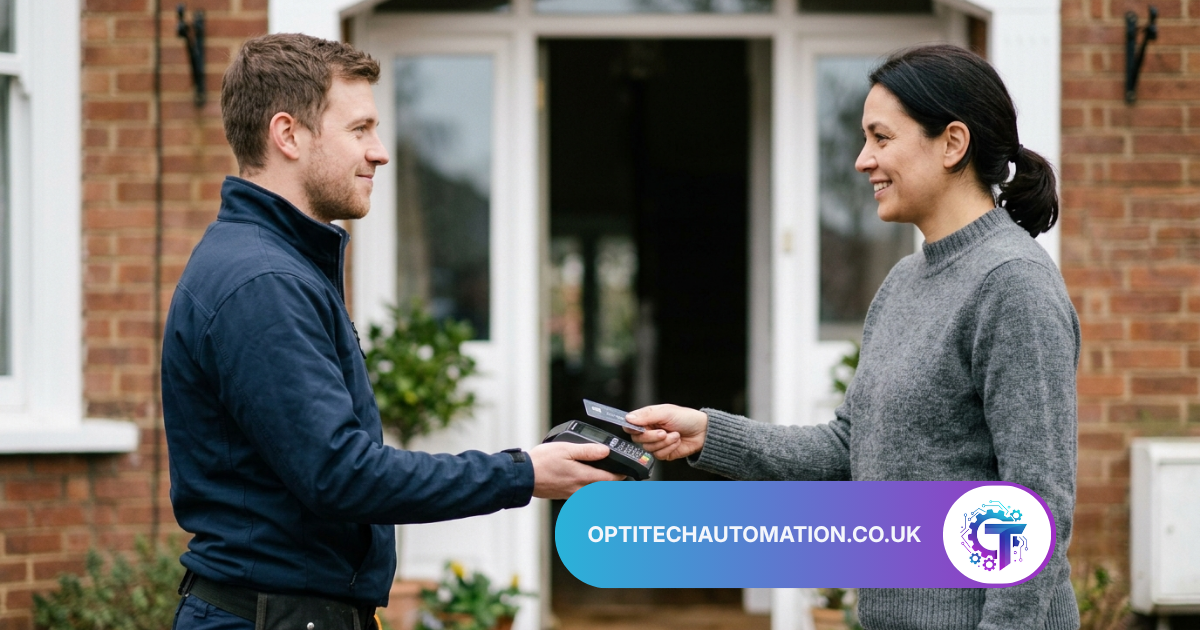
To take card payments as a UK tradesperson you need one of three things: a card reader for tapping on the doorstep, payment links you send by text or email, or a booking system with payments built in. Most trades end up wanting the second or third, because the expensive part of getting paid is not the card fee. It is the chasing, and readers do not fix chasing.
Here is how to choose, and what the fees really buy you.
Why take cards at all?
Because the way you get paid shapes when you get paid. A bank transfer is a promise: the customer will do it tonight, then tomorrow, then when they are next on their banking app. Every day in between is your money financing their week, and the 9pm chasing messages are unpaid admin, which is why we wrote a whole guide on getting invoices paid on time.
A card payment is an event. It happens while you are stood there, or the moment they tap the link. Job done, money moving, no chase. Customers increasingly expect it too: plenty of households simply do not carry cash, and "sorry, bank transfer only" reads as slightly behind the times to the same customer who books everything else in their life online.
And for larger work, cards are how you take a deposit before the job, which is the single best protection against no-shows and cancelled Saturdays.
What are the options?
- A card reader. A small device paired to your phone; the customer taps on the doorstep. Cheap to start, universally understood. Its limit: it only works face to face, so it does nothing for deposits, remote invoices, or the customer who says "can I pay you later?"
- Payment links. You send a text or email, the customer pays on their phone. No hardware, works for deposits and for chasing at distance. The limit is that it is still manual: you are creating and sending each link, and reconciling what got paid against which job.
- Payments built into your booking system. The deposit is taken when the job is booked, the balance is requested when the job is marked done, and every payment is already matched to its job and customer. Nothing to reconcile, nothing to remember. This is the version where getting paid stops being a task at all.
The rough fee shape at the time of writing: UK card processing generally lands somewhere around one to two percent plus pence per transaction (Stripe, for instance, publishes its UK card rates on its website). The question that actually separates providers is not the processing fee, it is what sits on top.
What should you check before signing up?
- Does the platform take its own cut? Some software adds a platform commission on top of card processing. On a year of trade invoices, a percentage skim is real money. Ask the question in exactly those words: "on a £1,000 invoice, how much reaches my bank?"
- How fast is the payout? Days matter when materials are on your card.
- Are refunds and disputes handled humanly? One awkward chargeback will teach you what support is like. Better to ask first.
- Does it match how you actually work? If half your jobs need deposits and remote payment, a doorstep-only reader solves the wrong half.
Where OptiTech Automation fits
Payments are wired through everything OptiTech Automation does: deposits taken at booking, the balance requested on completion, every payment matched to its job, and our commission on your payments is 0%, so beyond the card processor's own published fee, your earnings land straight in your own account. We think your invoices are none of our business model. Card processing runs on Stripe, the same infrastructure the big platforms use, and the whole price list is public on our pricing page.
Where we are the wrong choice: if you only want a doorstep reader and nothing else, buy just the reader. We make sense when the payment is one link in a chain you want handled, from the enquiry through the booking to the money landing.
Common questions about taking card payments
What are the options for taking card payments?
Three. A card reader paired to your phone, which works face to face only. Payment links sent by text or email, which work at a distance but stay manual. Or payments built into your booking system, where the deposit is taken at booking and the balance requested on completion, already matched to the job.
What do card payments actually cost?
UK card processing generally lands somewhere around one to two percent plus pence per transaction, and processors publish their own rates. The figure that varies far more is what sits on top: some software adds its own platform commission. Ask it plainly, on a £1,000 invoice, how much reaches my bank?
Is a card reader enough on its own?
Only if all your money changes hands on the doorstep. A reader does nothing for deposits taken before a job, nothing for a remote invoice, and nothing for the customer who says they will pay later. If half your work needs money before the van arrives, a doorstep only device solves the wrong half.
What should I check before signing up to a payment provider?
Four things. Whether the platform takes a cut on top of card processing. How fast the payout reaches your bank, which matters when materials are on your card. How refunds and disputes are handled, because one awkward chargeback teaches you what support is really like. And whether it fits how you actually get paid.
The move this week: count last month's invoices that took more than three days to arrive, and how many chasing messages they cost you. That number, not the card fee, is what a payment setup is priced against. Fix the chase and the fees look cheap.
If the chase is the expensive part rather than the card fee, the live demo shows the deposit and the balance being asked for automatically.
Keep reading


New here? See how OptiTech Automation works or view pricing. Or see what these figures mean for your business, in your own numbers.
Letters to the editor
Leave a letter
Add your name to the conversation. Approved letters appear within a day.