
Should I Raise My Prices? A UK Tradesperson's Decision Guide for 2026
If you haven't put your prices up in 12 months, you've taken a real-terms pay cut. Here's a clear framework for deciding when to raise, by how much, and how to tell existing customers without losing them.
Last edited: 03 Oct 2026
Everything described here runs on the same diary you can open in the live demo.
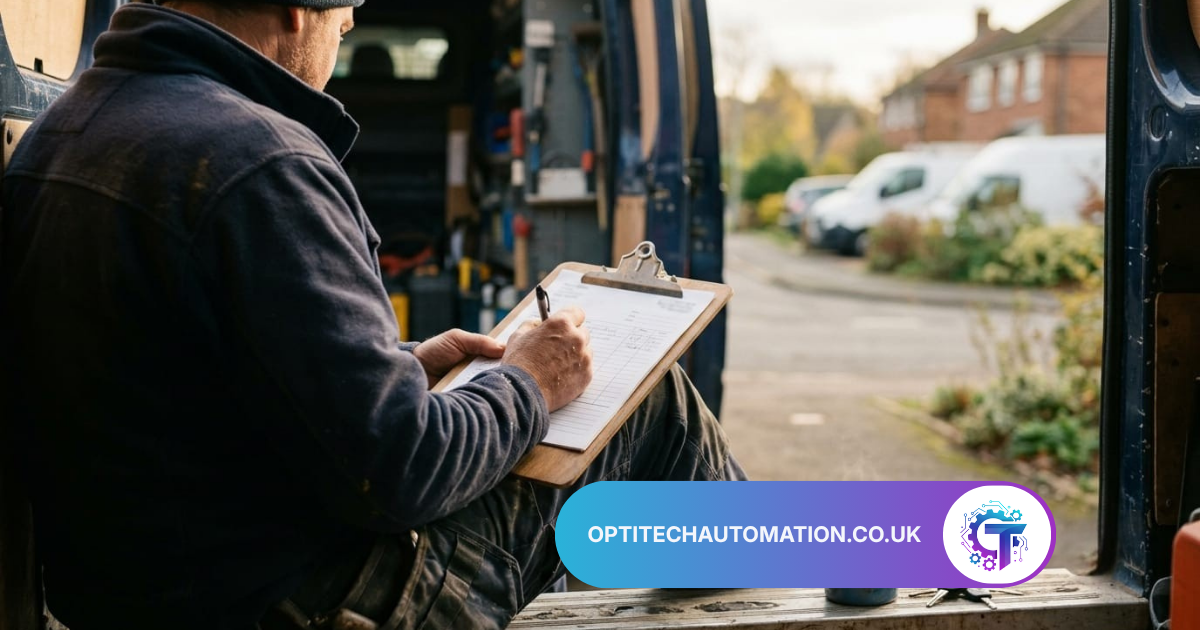
If you haven't raised your prices in the last 12 months, you should almost certainly raise them now, because standing still on price while fuel, materials and insurance keep climbing means you've already taken a real-terms pay cut. The question isn't usually whether to raise, but by how much and how to do it without spooking your best customers.
I talk to tradespeople across Devon who haven't touched their day rate since before the cost-of-living squeeze, and they can't work out why money feels tighter every year despite working just as hard. The answer is simple: their costs went up and their prices didn't. The market moved and they stayed put.
The inflation maths nobody runs
Your costs have not stood still, even if your prices have. Over the last couple of years, diesel, copper, timber, insurance premiums and merchant prices have all climbed. If your rate is the same as it was two years ago, your buying power has fallen by whatever inflation has done in the meantime, and that's a pay cut you never agreed to.
The brutal truth: doing nothing is a decision. It's just a decision to earn less every year. Raising your prices isn't greed, it's keeping pace with a world that's getting more expensive to operate in. If you've never worked out your true number, start with our guide on how much a tradesman should charge per hour and use the formula there as your baseline.
The 5 signals it's time to raise
- You're fully booked weeks ahead. Demand is outstripping your supply, the clearest signal of all.
- You're turning jobs down. If you're saying no to work, your price is filtering too little. Raise it and let price do the filtering.
- You never get pushback on quotes. If everyone says yes instantly, you're cheap. A healthy quote gets the occasional "that's a bit more than I hoped."
- Your rate hasn't moved in two years. Self-explanatory: the world moved, you didn't.
- You're not hitting your target take-home. If the wage you want isn't landing in your account, the maths has already told you the answer.
How to calculate how much to raise
Don't pluck a number out of the air. Stack three things:
- CPI / inflation since your last increase: this is the bare minimum just to stand still.
- Your own cost increases: if your insurance and van costs jumped more than inflation, reflect that.
- The gap between your current rate and the rate the formula says you should be on.
Add those up and you've got a defensible, honest increase. For most tradespeople who've held still for a couple of years, a 10 to 20% rise is fair and overdue. Don't be shy, because a £2 increase doesn't even cover the inflation you've absorbed.
Raise on new enquiries first
Here's the easiest move there is: new customers have no anchor. They don't know what you charged last year, so a new enquiry simply gets the new price. No conversation, no awkwardness, no risk. Roll the higher rate out on every new quote immediately, and that alone lifts your average without a single difficult chat. Then deal with your existing regulars separately and more gently.
The script for telling existing customers
For your regulars, warmth and brevity win. Don't apologise, don't over-explain, don't grovel. Something like:
"Just a heads-up, from the 1st of next month my rates are going up slightly to keep pace with rising costs. You'll still get the same service and I'll always do right by you. Wanted to let you know in good time."
Short, confident, non-apologetic. You're informing, not asking permission. Most good customers expect it and respect it, because they put their own prices up too.
Handling pushback without caving
Some will grumble. Hold your line politely. Acknowledge it ("I completely understand, costs are tough for everyone"), restate the value ("you know I turn up when I say and the work's right"), and don't immediately discount. If you cave the moment someone frowns, you've trained them to frown. The customers worth keeping rarely walk over a fair, well-communicated rise. A specific, confident quote makes the higher number easier to hold, and the one-page format is in how to write a quote that wins the job.
Scorecard: charge now, raise on new only, or hold?
Score each line 0, 1 or 2 and add it up.
- It's been over a year since my last increase. Over two years = 2, about a year = 1, under a year = 0.
- I'm fully booked or turning work away. Yes = 2, sometimes = 1, no = 0.
- Nobody pushes back on my quotes. Nobody ever = 2, occasionally = 1, regularly = 0.
- I'm not hitting my target take-home. Not close = 2, nearly = 1, yes I am = 0.
0 to 2: Hold for now, and review again in six months. 3 to 5: Raise on new jobs only, lifting every new quote and leaving regulars for now. 6 to 8: Raise across the board now, regulars included, because you're overdue and underpaid.
A higher number lands better when the booking around it feels sharp, and the live demo shows what the customer actually goes through.
Frequently asked questions
How much notice should I give existing customers?
For domestic regulars, a few weeks' heads-up is courteous and more than enough. There's no fixed legal notice period for one-off quoted work, since each new job is its own agreement at the new price. Telling them before they ask is what keeps it comfortable.
Am I legally obliged to keep my old price?
No. Unless you're mid-way through an agreed fixed-price job or a written contract that locks the rate, you're free to set a new price for new work whenever you like. What you cannot do is change the number on a job already quoted and accepted.
Should I offer loyal customers a discount?
You can hold them at a slightly lower rate if you genuinely value the relationship, but don't freeze them forever. A smaller increase for regulars still moves you forward, whereas frozen-forever pricing just means you subsidise loyalty out of your own wage.
What if I lose customers?
You might lose a few of the most price-sensitive ones, and that's usually fine. If a 15% rise loses you 10% of customers but the rest pay more, you often earn the same for less work. The customers who leave over a fair rise are rarely the ones you want.
How often should I review prices going forward?
Build a yearly review into your calendar. Small, regular increases are far easier to communicate and absorb than one big shock after five years of standing still. Put the date in now, because the review that is not diarised is the one that never happens.
Key takeaways
- Standing still is a pay cut. If your rate hasn't moved in a year, inflation has already quietly cut your wage.
- Watch the five signals. Fully booked, turning work away, no pushback, stale rate, missing your target, any of these means raise.
- Stack the increase. Inflation + your cost rises + the gap to your formula rate = a fair, defensible number.
- Raise on new enquiries first. New customers have no anchor, so it's the easiest lift you'll ever make.
- Tell regulars warmly, not apologetically. Short, confident, in good time, and you're informing rather than asking.
- Hold your line on pushback. Acknowledge, restate the value, don't reflexively discount.
A price rise only sticks if your systems back it up: clean quotes, deposits up front and invoices that get paid. OptiTech Automation makes the higher number feel effortless to the customer and certain for you. Look at our pricing page, get in touch to talk it through, or start onboarding today.
Keep reading
![How to Get More Jobs as a UK Tradesperson [2026]](https://xmsqilnftxjffjhofobn.supabase.co/storage/v1/object/public/cms-images/2026/49dc1eb6-8a38-4df4-97af-1ce676a85c09.png)

New here? See how OptiTech Automation works or view pricing. Or see what these figures mean for your business, in your own numbers.
Letters to the editor
Leave a letter
Add your name to the conversation. Approved letters appear within a day.